Familien stärken, Leben verbessern...jeden Tag
Resources > Tools and Information

Verhalten

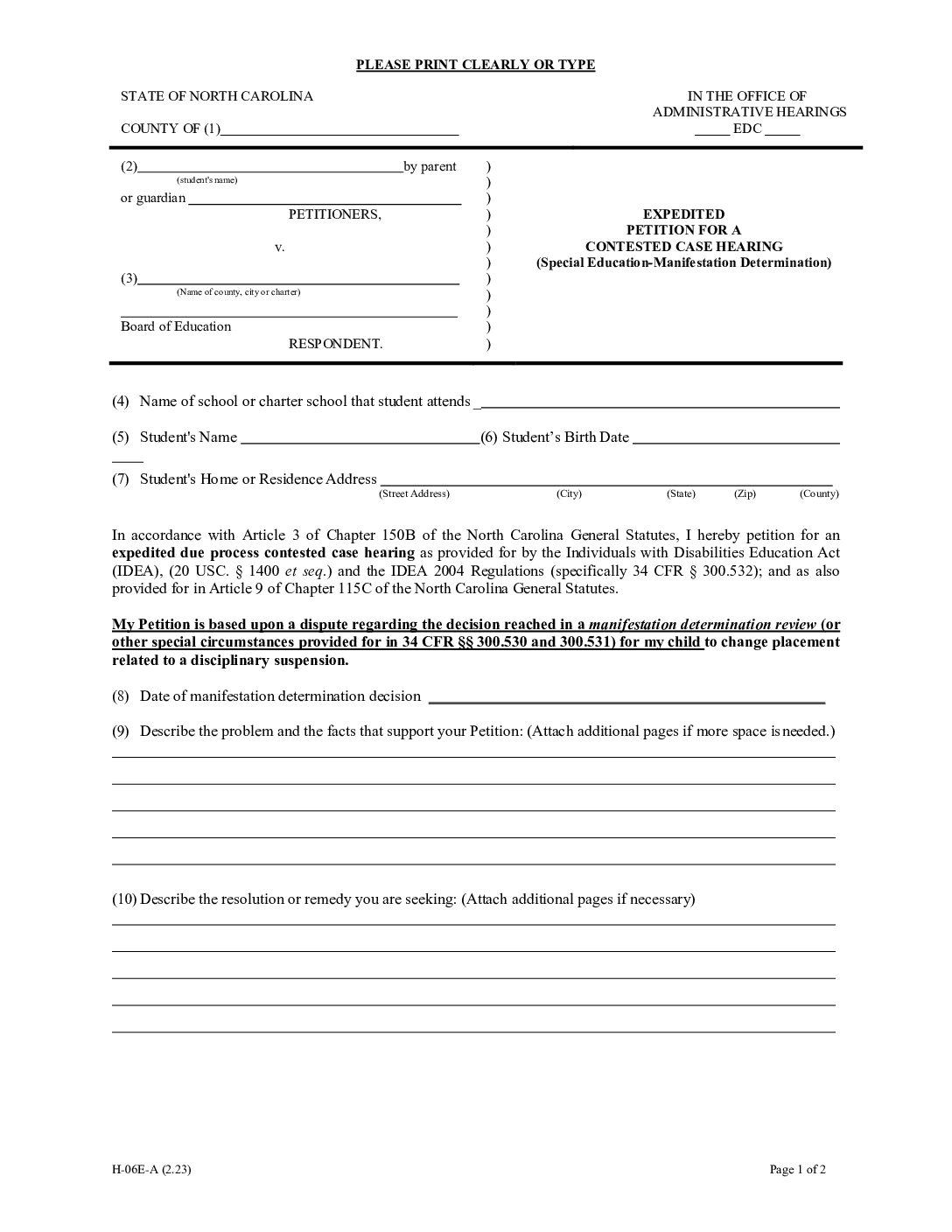
Manifestation Determination Special Ed
Expedited Petition for a Contested Case Hearing (Special Education - Manifestation Determination)
Kategorien: Verhalten
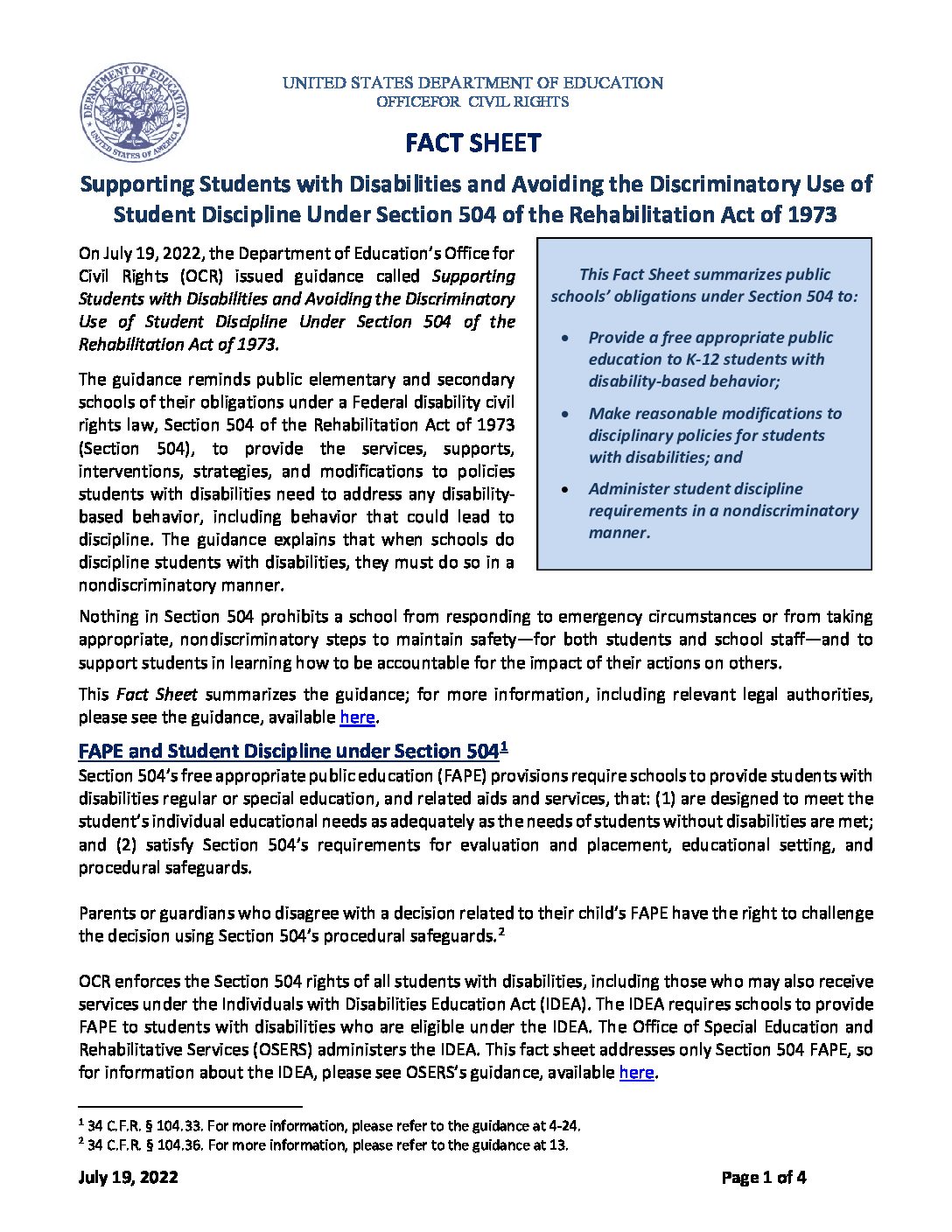
504-discipline-factsheet
FAKTENBLATT - Unterstützung von Schülern mit Behinderungen und Vermeidung der diskriminierenden Anwendung von Schülerdisziplinen gemäß Abschnitt 504 des Rehabilitationsgesetzes von 1973
Neue Leitlinien des US-Bildungsministeriums zur Disziplinierung von Schülern mit Behinderungen.
Categories: 504, Behavior, IDEA
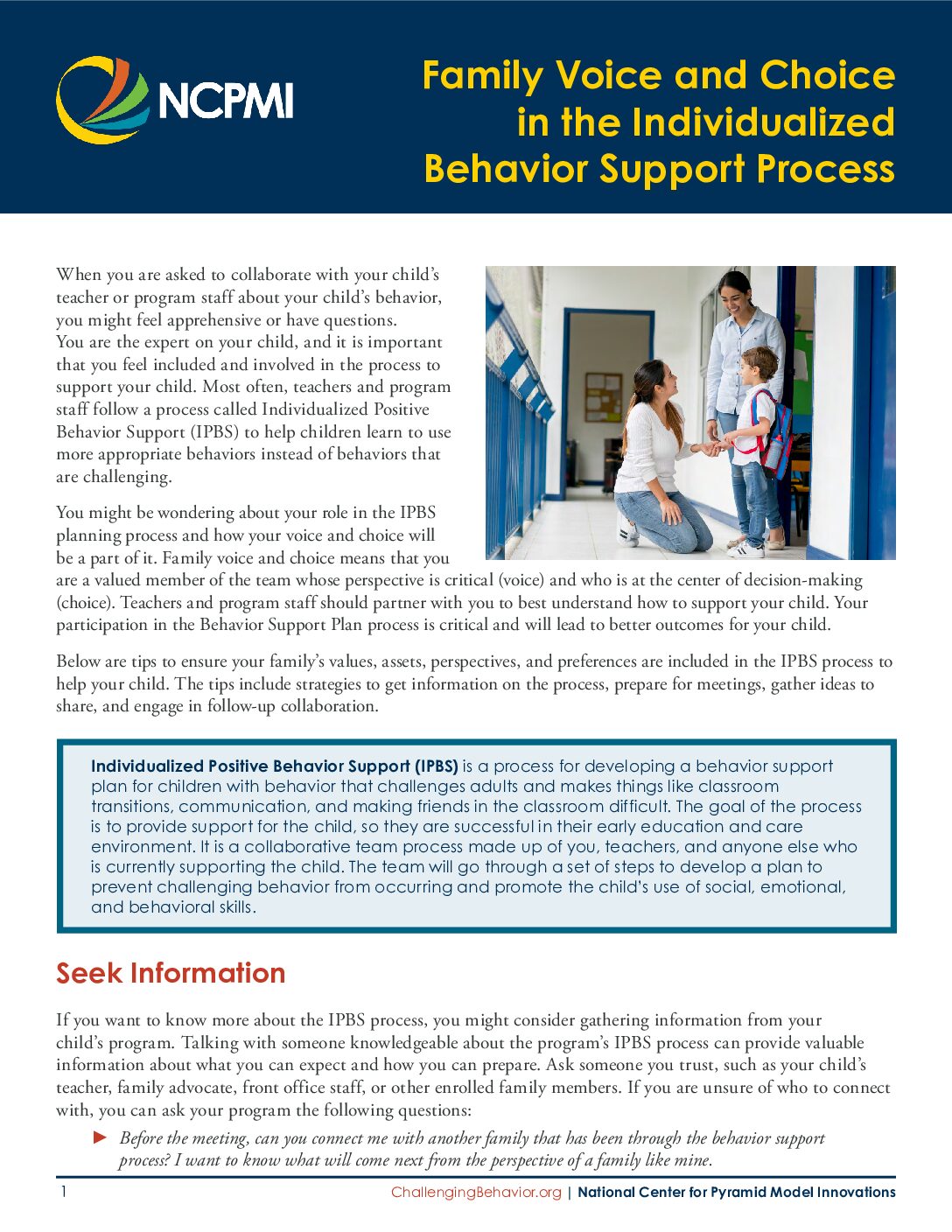
family_voice_choice
Family Voice and Choice in the Individualized Behavior Support Process
Empowering families to be active and valued participants in the Individualized Positive Behavior Support Plan (IPBS) is foundational to the Pyramid Model. This set of tips and strategies helps families ensure their values, assets, perspectives, and preferences are included in individualized support for their children.
Kategorien: Verhalten
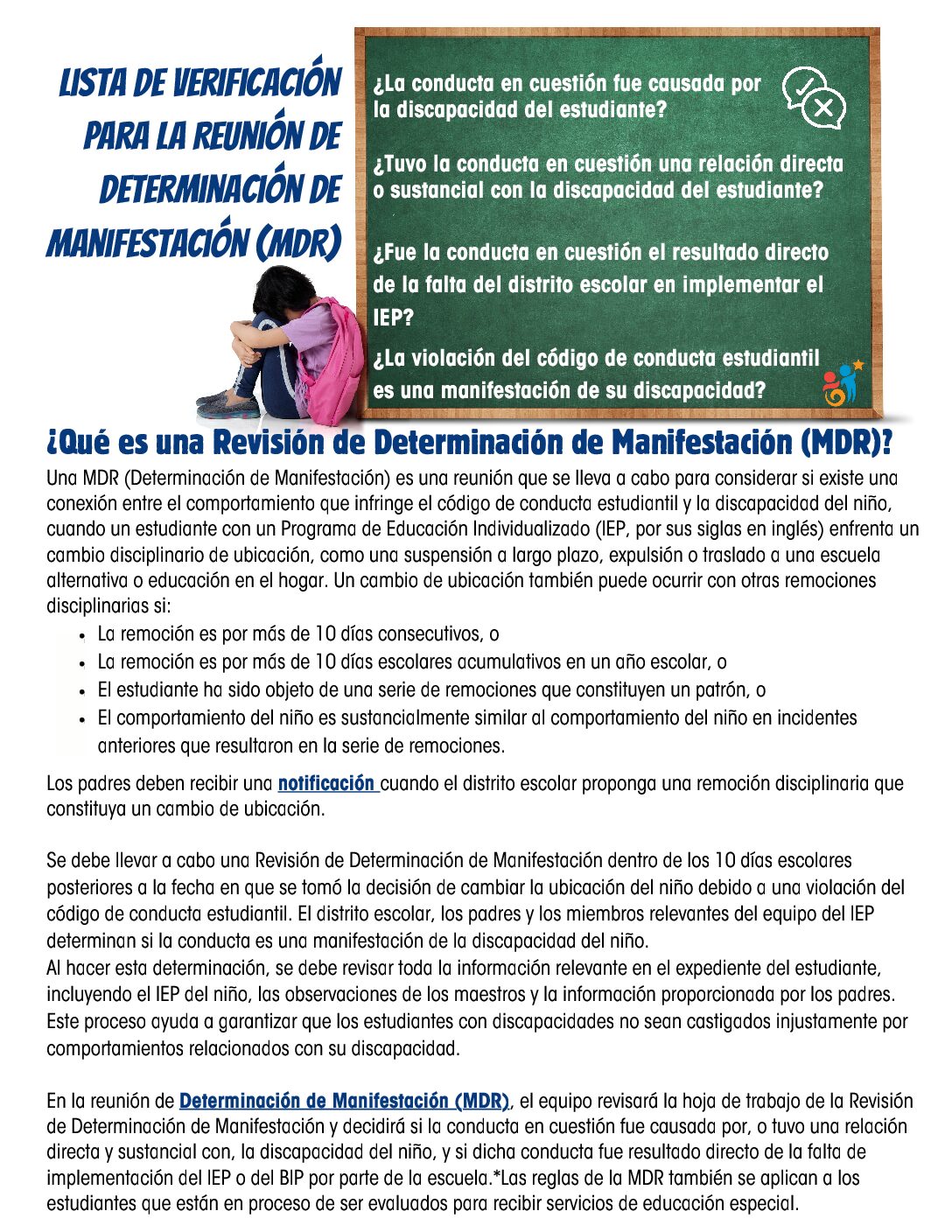
Spanish MDR 6.10.25
Lista de Verificación para la Reunión de Determinación de Manifestación (MDR)
Una MDR (Determinación de Manifestación) es una reunión que se lleva a cabo para considerar si existe una conexión entre el comportamiento que infringe el código de conducta estudiantil y la discapacidad del niño, cuando un estudiante con un Programa de Educación Individualizado (IEP, por sus siglas en inglés) enfrenta un cambio disciplinario de ubicación, como una suspensión a largo plazo, expulsión o traslado a una escuela alternativa o educación en el hogar.
Categories: Behavior, Spanish
ENGLISH MDR 4.25
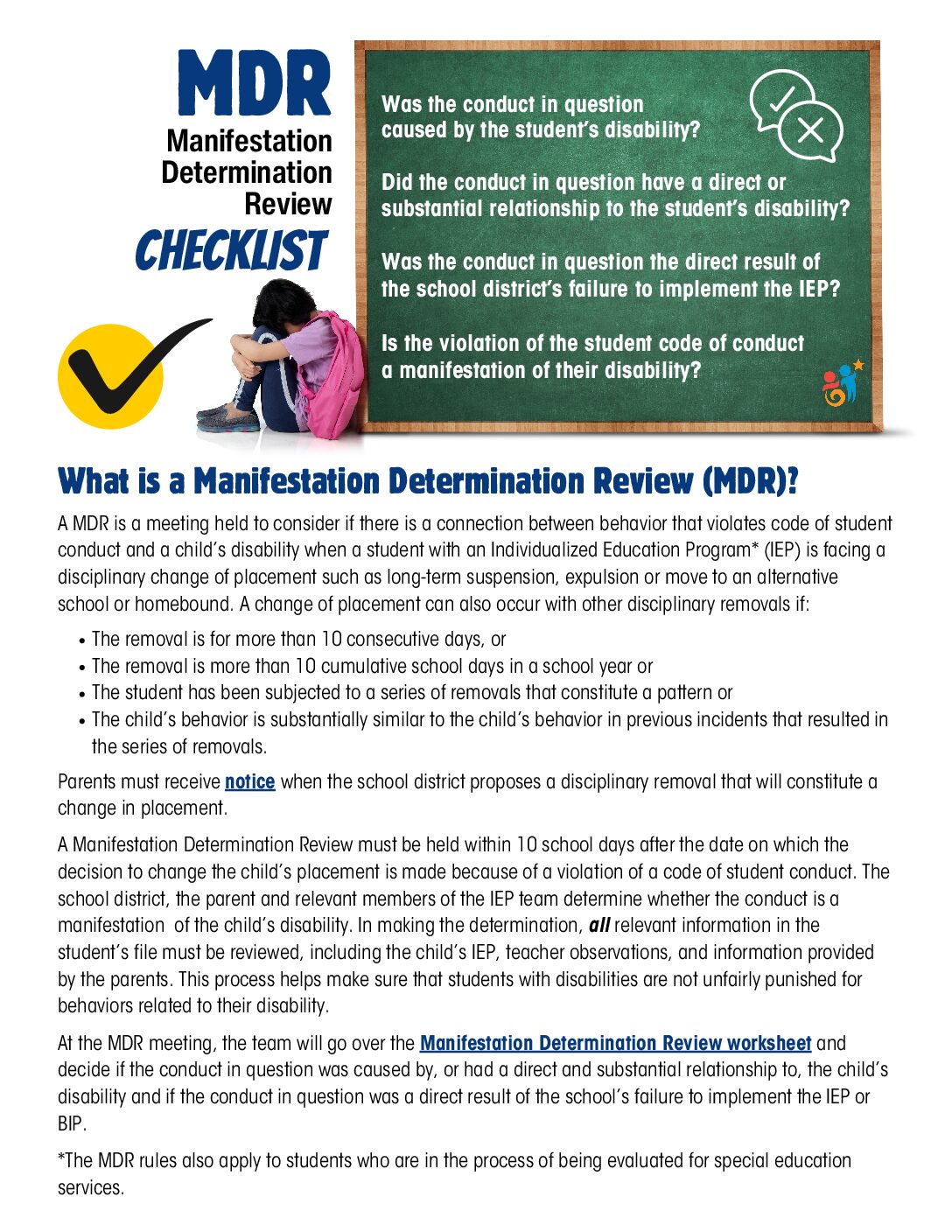
Manifestation Determination Review (MDR) Checklist
A MDR is a meeting held to consider if there is a connection between behavior that violates code of student conduct and a child’s disability when a student with an Individualized Education Program* (IEP) is facing a disciplinary change of placement such as long-term suspension, expulsion or move to an alternative school or homebound.
Categories: Behavior, IEP, Parent Rights, Special Education
NASET-Manifestation-Determinations_-A-Quick-Guide-for-Educators-01.16.26 (1)
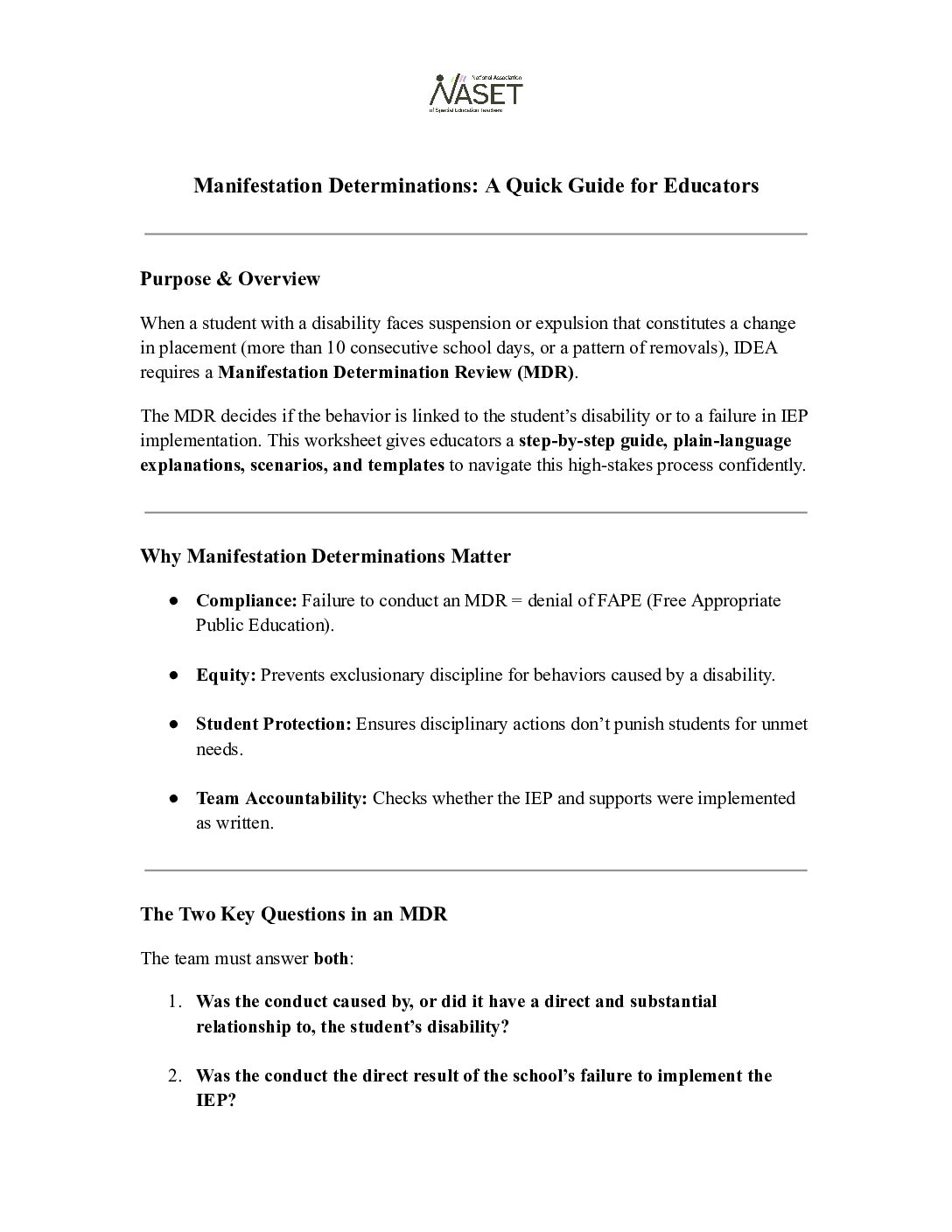
Manifestation Determinations: A Quick Guide for Educators
When a student with a disability faces suspension or expulsion that constitutes a change in placement (more than 10 consecutive school days, or a pattern of removals), IDEA requires a Manifestation Determination Review (MDR). The MDR decides if the behavior is linked to the student’s disability or to a failure in IEP implementation. This worksheet gives educators a step-by-step guide, plain-language explanations, scenarios, and templates to navigate this high-stakes process confidently.
Kategorien: Verhalten
ElternInfografik.10.2019
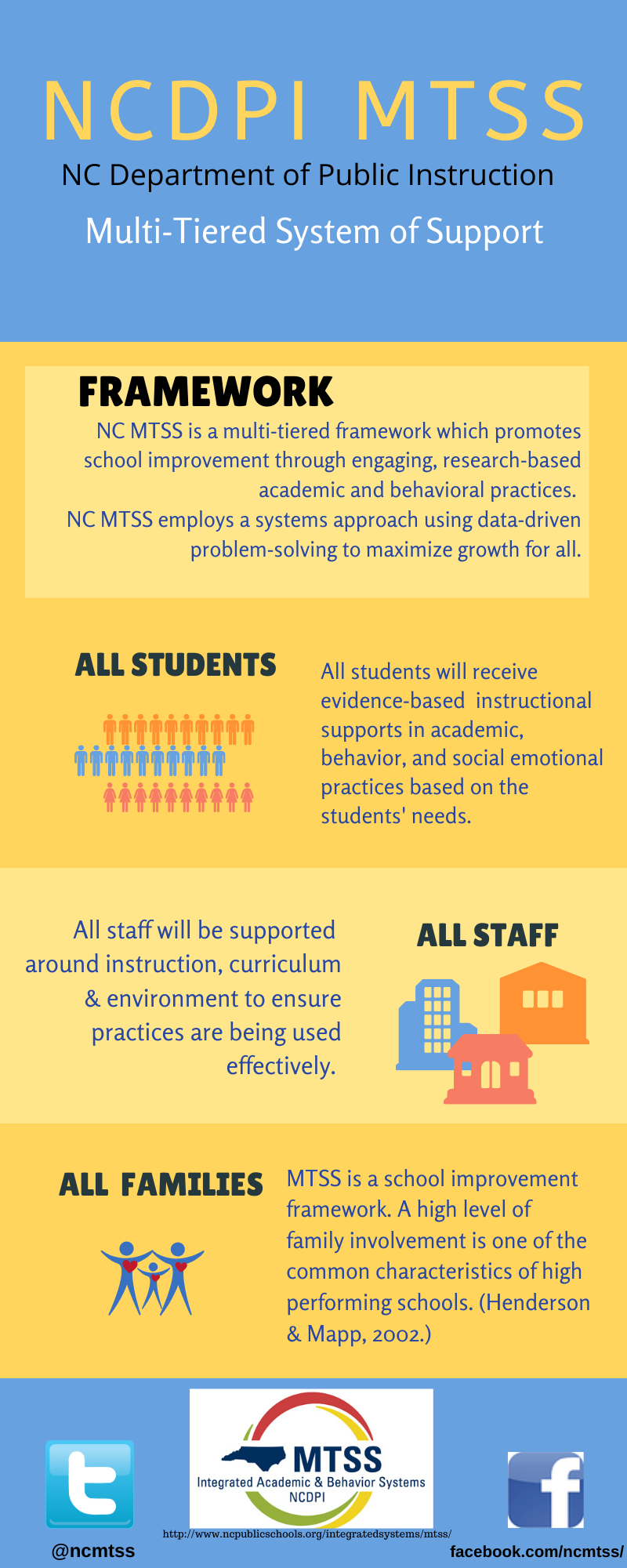
NCDPI-Infografik zum mehrstufigen System der Unterstützung (MTSS) für Familien
NC MTSS ist ein mehrstufiger Rahmen, der die Verbesserung der Schule durch engagierte, forschungsbasierte akademische und verhaltensbezogene Praktiken sowie soziales emotionales Lernen (SEL) fördert. NC MTSS verwendet einen Systemansatz, der datengestützte Problemlösungen einsetzt, um das Wachstum für alle zu maximieren.
Kategorien: Verhalten, MTSS
Aus-den-Schatten-treten-1
Aus dem Schatten treten
Informieren Sie sich über die informelle Entfernung von Kindern mit Behinderungen aus öffentlichen Schulen.
Categories: Behavior, Special Education
DP Petition for Hearing Form
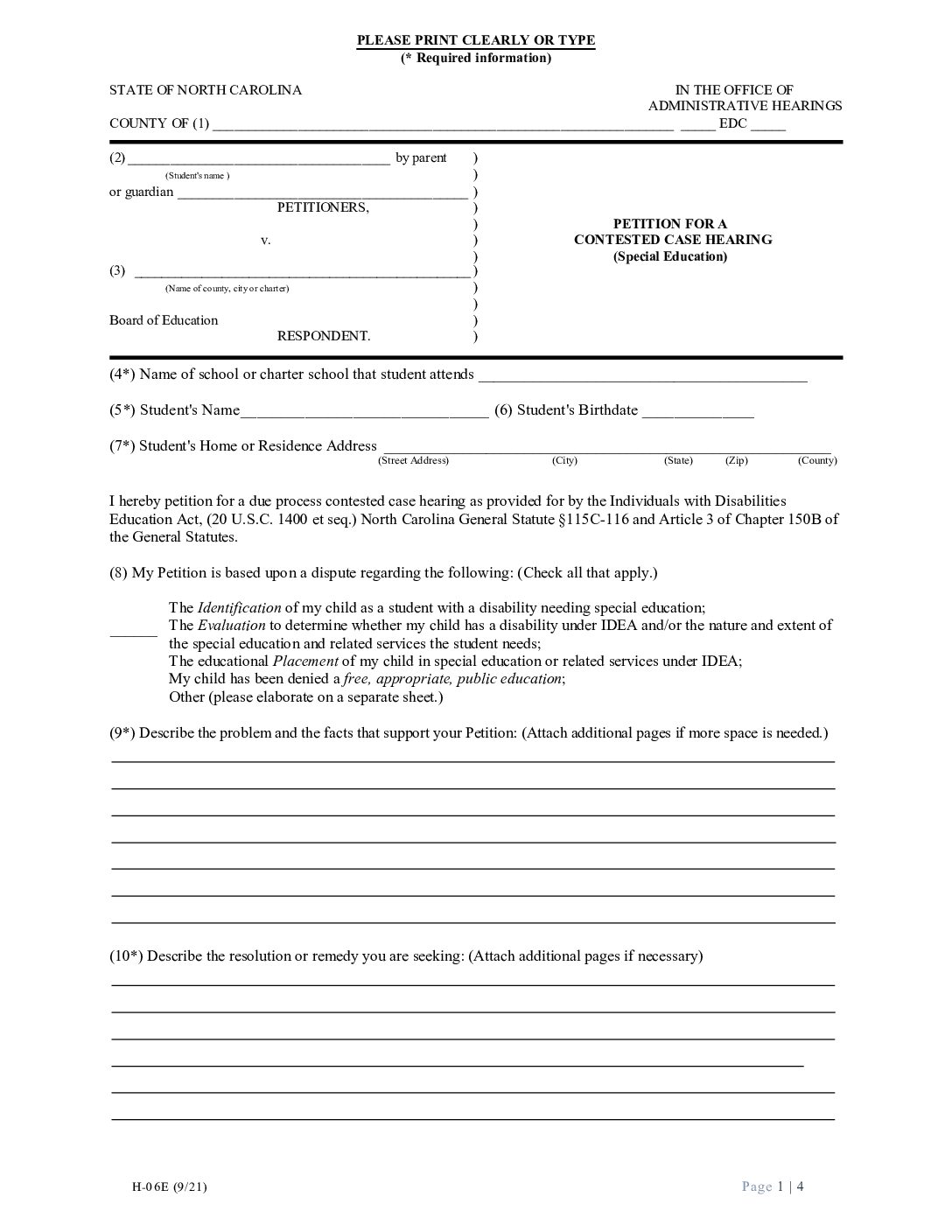
Petition for a Contested Case Hearing (Special Education)
Kategorien: Verhalten
guide-positive-proactive-approaches-to-supporting-children-with-disabilities
Positive, Proactive Approaches to Supporting Children with Disabilities: A Guide for Stakeholders
U.S. Department of Education, Office of Special Education and Rehabilitative Services
Kategorien: Verhalten
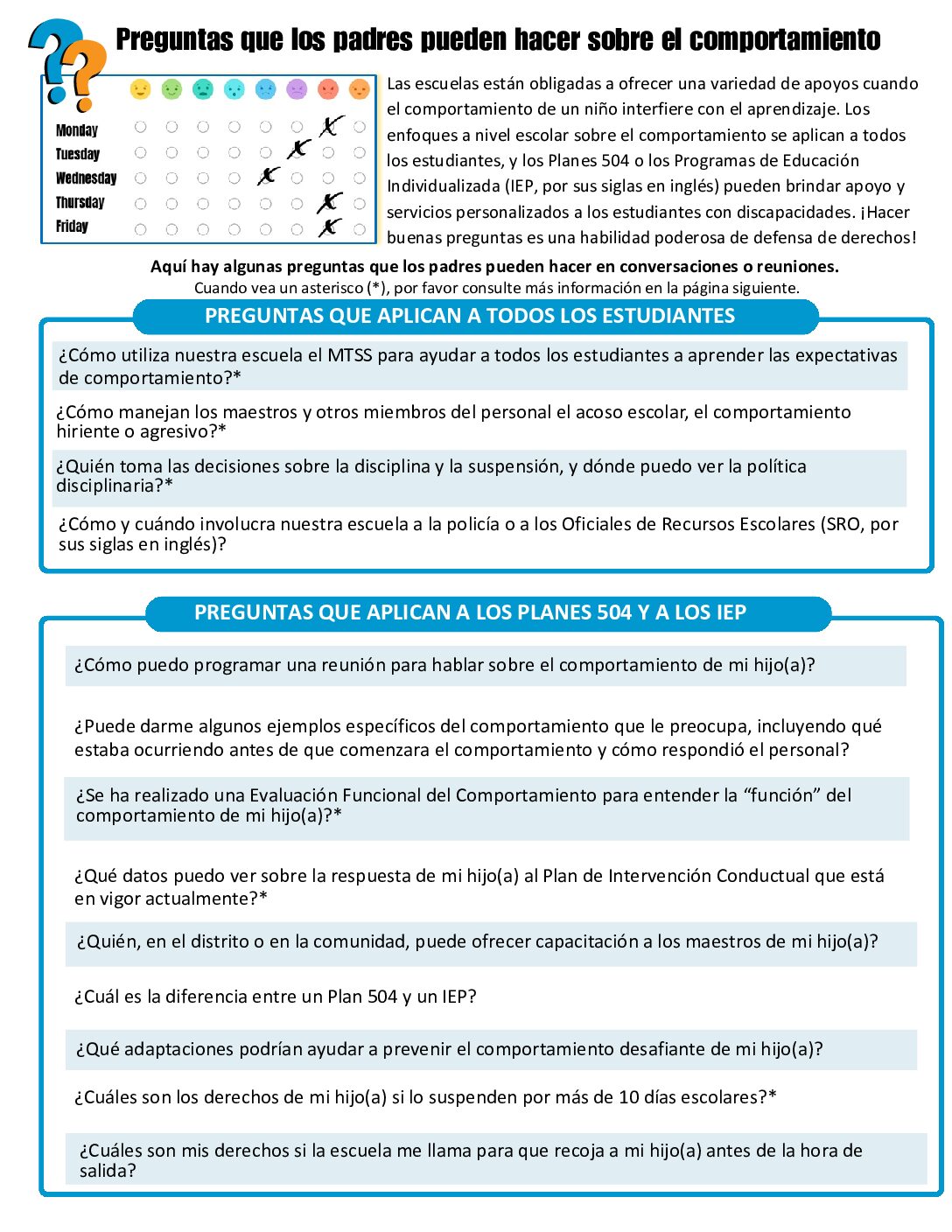
SPANISH - Questions Parents can Ask About Behaviors (1)
Preguntas que los padres pueden hacer sobre el comportamiento (Questions Parents Can Ask About Behavior)
Aquí hay algunas preguntas que los padres pueden hacer en conversaciones o reuniones.
Categories: Behavior, IEP, Spanish
qa-addressing-the-needs-of-children-with-disabilities-and-idea-discipline-provisions
Questions and Answers: Addressing the Needs of Children with Disabilities and IDEA's Discipline Provisions
From the U.S. Department of Education, Office of Special Education and Rehabilitative Servies
Kategorien: Verhalten, IDEA
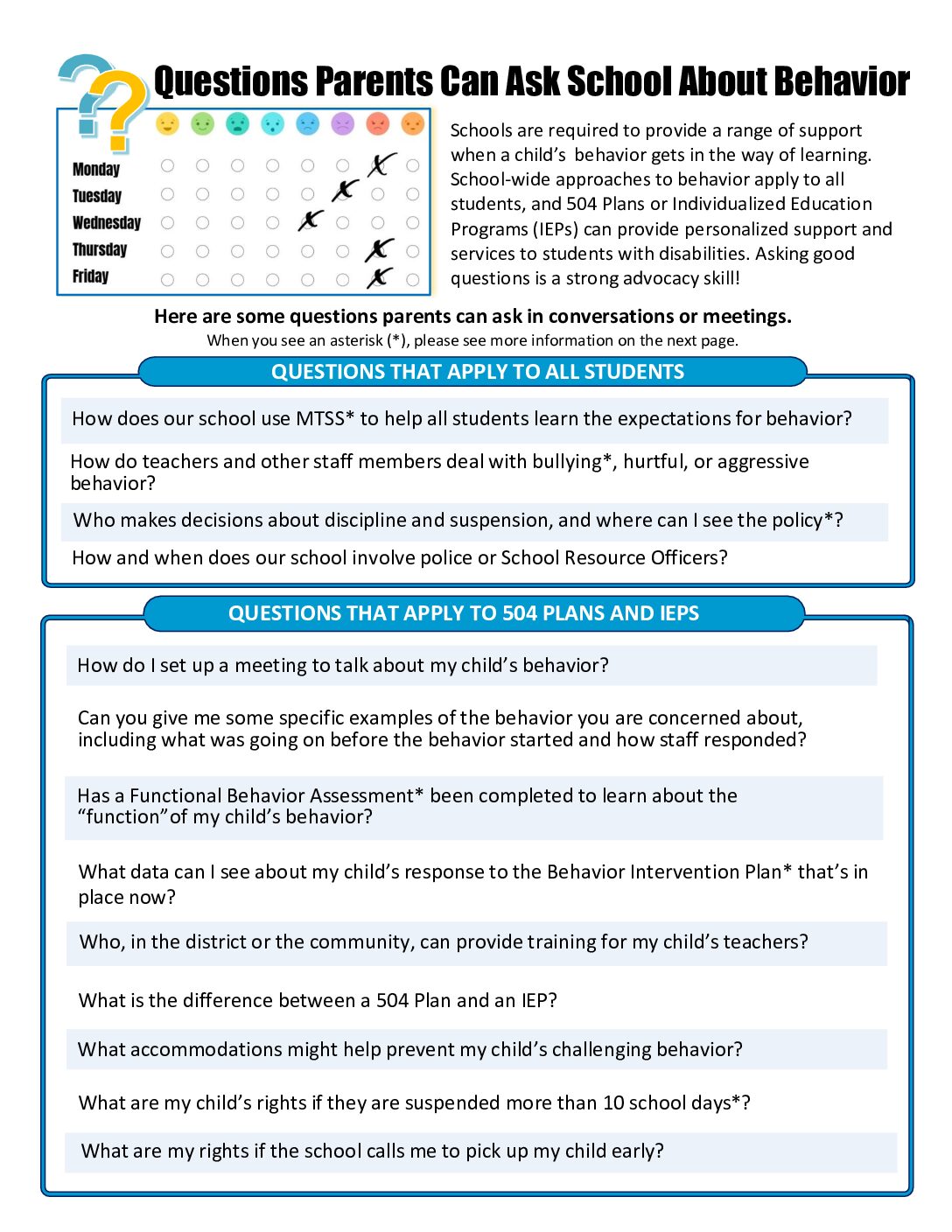
Questions Parents can Ask About Behaviors 11.24
Questions Parents Can Ask School About Behavior
Schools are required to provide a range of support when a child’s behavior gets in the way of learning. School-wide approaches to behavior apply to all students, and 504 Plans or Individualized Education Programs (IEPs) can provide personalized support and services to students with disabilities. Asking good questions is a strong advocacy skill!
Categories: Behavior, Communication, Special Education
helping_fams_navigate_conversations
Receiving News About Your Child's Day: Navigating Conversations Around Behaviors
This family handout provides guidance on navigating conversations when receiving news about their child’s behavior. Families can use this resource to find ideas and tips for collaborating with their child’s program and teachers, including specific questions to ask and prompts to start collaborative conversations.
Kategorien: Verhalten
504-discipline-guidance
Section 504 Discipline Guidance
Supporting Students with Disabilities and Avoiding the Discriminatory Use of Student Discipline under Section 504 of the Rehabilitation Act of 1973, U.S. Department of Education Office for Civil Rights, July 2022
Categories: 504, Behavior
spporting_behavior_through_connection
Supporting Behavior Through Connection
Supporting behavior through connection is a practical resource for families and early childhood practitioners that shifts the focus from compliance to connection. It offers simple, relationship-centered strategies for responding to challenging behavior that help children feel safe, valued, and supported. The resource describes three practices, including examples and prompts, that can be used in everyday routines to build trust and connection with children.
Kategorien: Verhalten
supporting_your-child
Supporting Your Child After Stressful Events
This resource offers guidance on supporting children after stressful events and includes strategies for families and caregivers to create safety and predictability through routines, clear communication, and emotional connection.
Kategorien: Verhalten
Tipps zur Vorbeugung von herausfordernden Verhaltensweisen
Tipps zur Vorbeugung und erfolgreichen Reaktion auf herausfordernde Verhaltensweisen
Erzieherinnen und Erzieher können die folgenden Strategien und Links zu ergänzenden Ressourcen nutzen, um PRÄVENTIV zu sein, indem sie Verhaltensdysregulationen reduzieren, und RESPONSIV zu sein, indem sie die Entwicklung unterstützen, wenn schwierige nonverbale Kommunikation auftritt.
Kategorien: Verhalten, Frühkindliche Entwicklung
Functional-Behavioral-Assessments-11-19-2024
Using Functional Behavioral Assessments to Create Supportive Learning Environments
From the U.S. Department of Education - Using Functional Behavioral Assessments to Create Supportive Learning Environments, guidance to help schools and early childhood programs better support students’ behavioral needs. This guidance focuses on evidence-based practices to support students, with or without disabilities, whose behavior interferes with learning, and is part of the Department’s effort to reduce exclusionary discipline.  
Categories: Behavior, Special Education
PBIS-Ressourcen-Miniaturansicht
Was sind positive Verhaltensinterventionen (oder Anweisungen) und Unterstützungen (PBIS)?
PBIS ist ein personenzentrierter und forschungsbasierter Ansatz, der sich darauf konzentriert, die Verhaltensweisen zu lehren, die wir in der Schule, zu Hause und in der Gemeinschaft sehen wollen...
Kategorien: Verhalten
Gestern vs. Heute - Miniaturansicht der Ressourcen
Verhalten gestern vs. heute
Vergleich zwischen dem traditionellen Verhaltensmanagement von gestern und der positiven Verhaltensunterstützung von heute...
Kategorien: Verhalten